Gunnar M. Schröeder
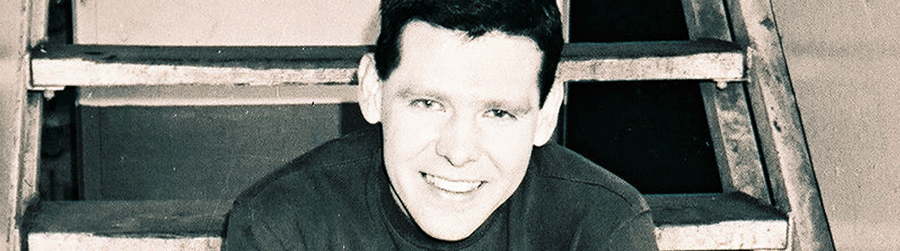
My name is Gunnar Milkhause Schröeder, and if you’re wondering about the umlaut over the ö, yes, it’s real. So is the head full of voices. When I was a child, I didn’t just daydream—I conducted symphonies of imagination. Entire civilizations rose and fell behind my eyelids. Mars wasn’t just a red dot in a textbook; it was a desert kingdom ruled by librarians who rode sand-foxes. The moon? A quiet retreat for retired astronauts who’d grown tired of breathing and just wanted to float in peace. I climbed Everest in my socks, scaled Machu Picchu between math problems, and once walked the Amazon rainforest during a particularly long lunch detention.
I called it a blessing. My mother called it “Gunnar being Gunnar.” Either way, it kept me company.
By the time I was nine, I’d started writing those worlds down. My notebook—grey with a frayed spiral and a sticker of a rocket that had long ago surrendered to time—became my closest confidant. I wrote stories in crayon, then pencil, then ink. I wrote so much that my teacher once asked if I had a pen addiction. I said yes, and she laughed. Then she gave me extra paper. Teachers are saints, really.
When I got my first computer—a hand-me-down Compaq with a keyboard that clicked like a disapproving grandmother—I wept. Not because it was beautiful (it wasn’t), but because now I could write faster than my thoughts. I could fly.
Then, in the late ’90s—maybe 1997, possibly 1998; history blurs when you move countries—I landed in the United States. Washington State. Seattle. I enjoyed visiting Walla Walla in my spare time. If you’ve never heard of it, don’t feel bad. Neither had I. But it has a high school, a Dairy Queen, and, as I would learn, an alarming number of people who thought “Milkhause” was a joke. (Schröeder, by the way, means “barber.” I was constantly asked if I gave haircuts. I did not. I was terrible at hair.)
The bigger challenge, though, was English. My brain stuttered through American vowels. I learned by watching Follow Me, a BBC program aired on PBS at 6:03 a.m. sharp. I’d wake up, make tea like I was in some posh London flat, and repeat phrases with what I imagined was flawless Received Pronunciation. “Good morning, Mr. Matthews. Lovely weather for ducks.” Every day, I spoke to an imaginary Francis Matthews, who never responded but was always impressed.
Slowly, English became mine. Not perfect. Never perfect. But mine.
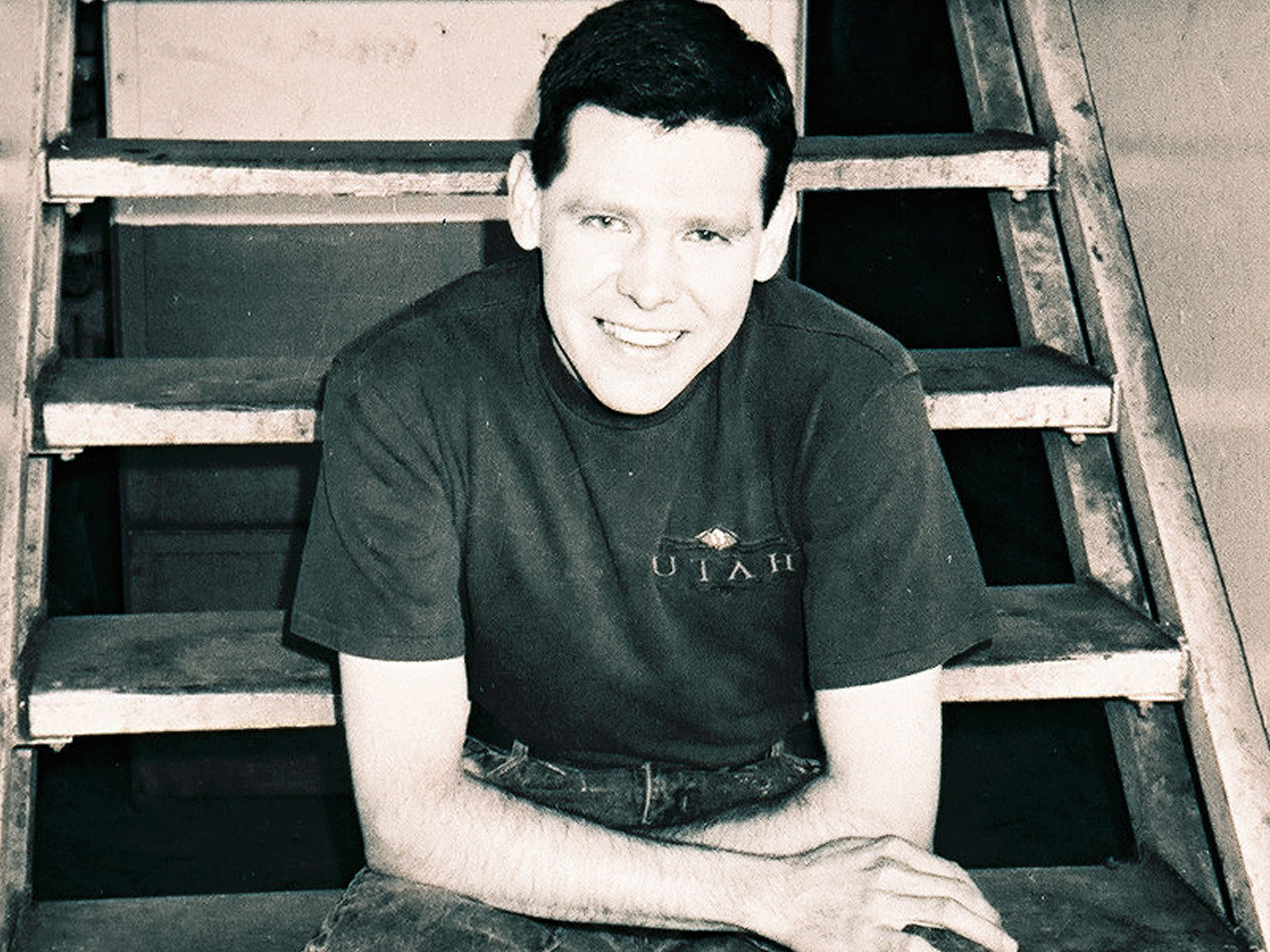
And so, I began writing again—this time in a new language. Sentences felt clunky, like I was building a treehouse with mittens on. But I kept at it. Every essay, every journal entry, every awkward love note I never sent—it was practice. Writing wasn’t just what I loved; it was how I survived.
Now, about the accent.
I V my W’s. I admit it. “Vhat,” “vonderful,” “verdict.” It slips out. There’s also a faint British inflection—probably Francis Matthews’ influence. People often say, “You sound German, but also… posh?” To which I reply, “I’m multilingual in my imagination.”
But my best friend George—bless his dramatic soul—tells everyone I am a fake. According to him, I am American. Born and bred in Washington State. According to him, we went to school together. I was a “certified nerd” at Wa-Hi (That is Walla Walla High School). Quiet guy. Sat in the back. Wrote stories during gym class. Had more conversations with staplers than humans. A pariah, as he so delicately puts it.
Then came the spring play: Twelfth Night. I was cast as Sir Andrew Aguecheek, a role I landed purely because the director mistook my nervous shuffling for comic timing. The character needed an accent—something absurd, foreign, flamboyant. So, I made one up. A blend of Bavarian, Shakespearean English, and a dash of what I can only describe as “confused penguin.”
The night of the performance, something magical happened. Girls looked at me. Not in horror. Not in pity. In amusement. And better yet, interest. One girl named Chloe even asked if I was from “the fancy part of Europe.” I said yes. I don’t even know if there is a fancy part of Europe, but I leaned into it.
George says that was the moment I became “the classy foreigner.” He claims the whole thing—the accent, the mannerisms, the subtle flair with which I say “indeed”—is performance. A lifelong act engineered to avoid social oblivion.
“To this day,” he’ll tell anyone within earshot, “Gunnar’s accent is 70% fabrication, 30% denial, and 100% attention-seeking.
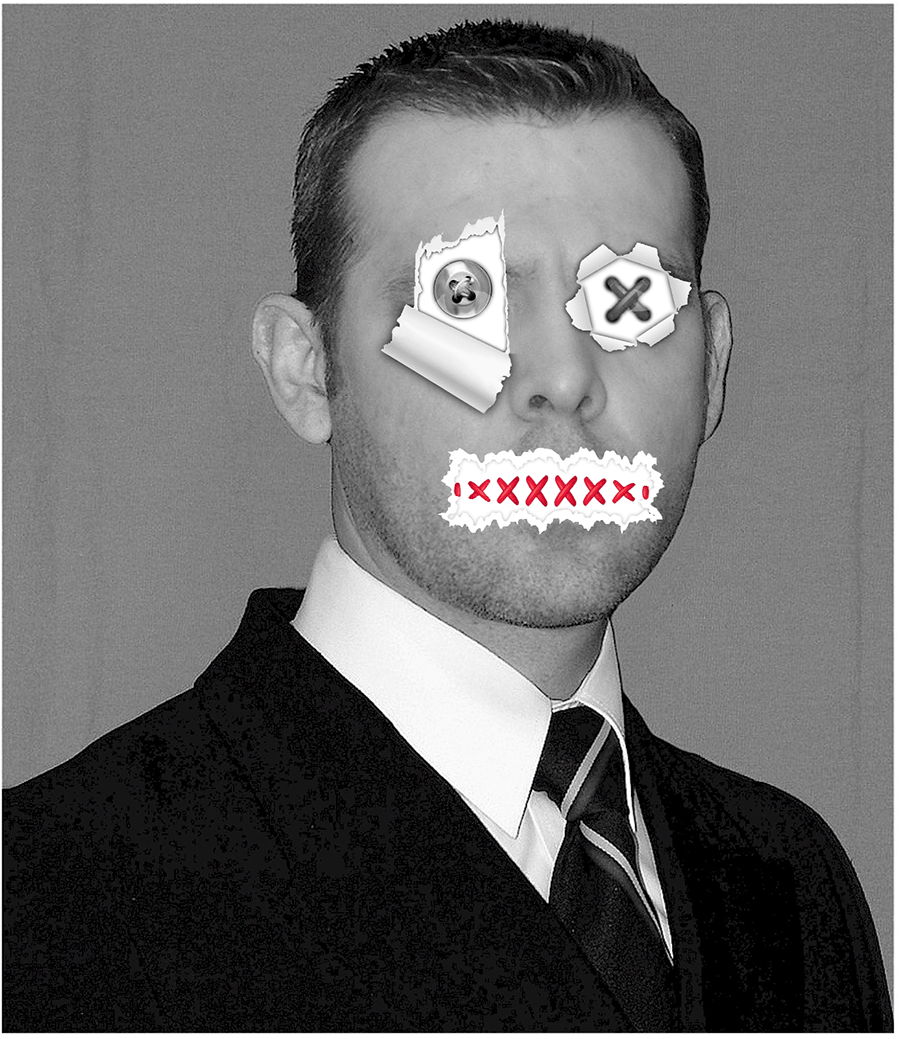
And sometimes, when I’m tired or excited, I slip. I say “dude.” I drop a “gonna.” I say “y’all” unironically in Idaho. That’s when George pounces.
“Your American is showing!” he’ll shout across the room, finger pointing like a judge delivering divine justice.
I’ll laugh. He’ll cackle. And the myth grows.
The truth? I don’t know where the accent ends and I begin. I am foreign. I am supposed to have an accent. But language, like identity, isn’t static. It evolves. I’ve lived in the U.S. longer than I lived anywhere else. I’ve written more stories in English than German, or Japanese, or Spanish. My brain is a linguistic stew—German grammar, British vowels, American slang, Mexican sayings, and a pinch of Martian dialect (never discount the Martian dialect).
George and I still argue about it. Last Christmas, he got me a mug that says “Fake Accent, Real Nerd.” I use it every morning.
Do I sometimes say “water” as “vah-ter” when no one’s listening? Probably. Do I do it because I think it sounds cool? Maybe. Do I also do it because it’s just… how my mouth remembers language? Absolutely.
I miss Walla Walla. I miss the Tri-Cities. I miss the way the wind smelled like onions in summer and the way George would groan when I used the word “fascinating” unironically. I miss being twenty-three and thinking English could change my life.
It didn’t change my life, really. But it helped me find my voice.
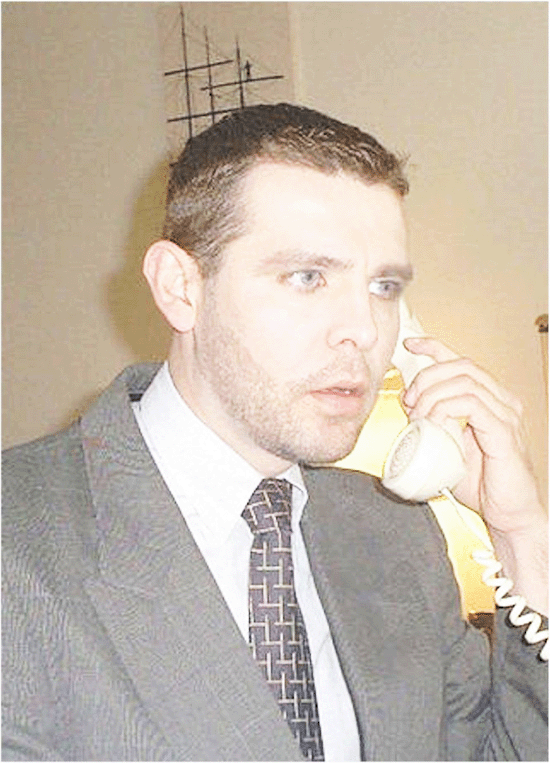
And if that voice happens to say “zat’s vunderful” with a wink and a smirk? Well. Let the record show: I never promised to be simple.
George has a way of making me feel like a riddle he’s invented but can’t quite solve. One minute, I’m a sophisticated foreigner who barely speaks English, the next, I’m a nerdy American from Walla Walla who speaks English with a foreign accent only to get attention.
I mentioned offhand that I’d been toying with the idea of a book—Something that I wrote after a trip to Cabo San Lucas. He laughed so hard, his salt-and-pepper beard twitched.
“A book?” he boomed, his voice drawing glances from nearby patrons. “Mein Gott, that’s ridiculous!” He wiped his eye, grinning. “You barely speak English!”
My book will have a dedication page.
“To George—who gave me ten nationalities and still says I don’t speak English. Thank you for the accent, the confusion, and the laughter. Now translate this into something I can understand.”